

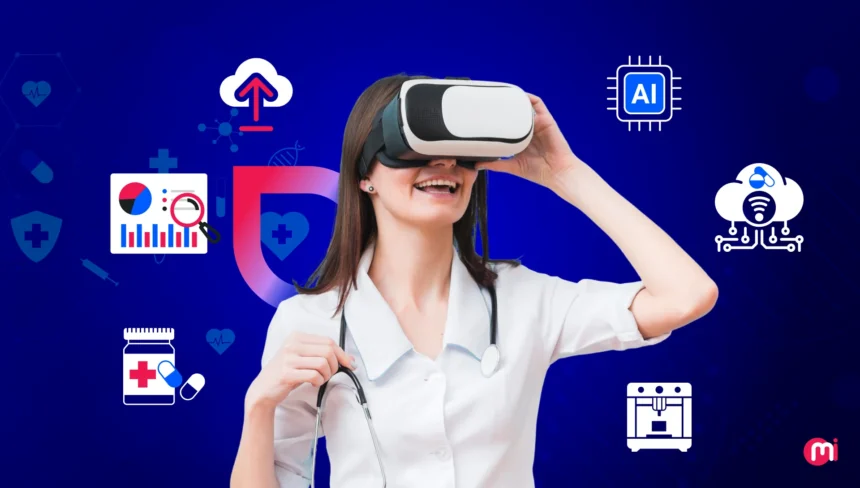
A significant transformation is underway in the global healthcare landscape as digital advancements permeate every aspect of care. Technologies like artificial intelligence (AI), telemedicine, wearable devices, and data-driven platforms are fundamentally changing the delivery and experience of healthcare.
Research indicates that the digital health market is poised for substantial growth, with projections suggesting a significant increase in market value over the coming years. This growth underscores the shift towards a new era where patients are actively engaged, care extends beyond traditional boundaries, and decisions are informed by data-driven insights.
From remote monitoring to AI-powered diagnostics, the evolution of healthcare technology is setting new standards, redefining roles, and reshaping the healthcare landscape. This article explores the top 10 healthcare technology trends driving this transformation, offering insights into their significance, real-world implications, and future implications for healthcare.
Key Takeaways
- Emerging healthcare technology trends such as AI and machine learning are revolutionizing clinical decision-making through predictive analytics and personalized care.
- The expansion of telehealth and Internet of Medical Things (IoMT) solutions is reshaping access to continuous, connected, and remote healthcare services globally.
- Cloud computing and interoperability are enhancing data sharing, facilitating secure collaboration, and streamlining digital transformation across healthcare ecosystems.
- Advancements in 3D printing and nanomedicine are driving precision medicine, enabling customized treatments and improving patient outcomes.
- Technologies like virtual reality (VR), augmented reality (AR), and neural interfaces are ushering in next-generation innovations in healthcare IT, enhancing medical training and care delivery.
10 Key Healthcare Technology Trends Transforming the Future of Medicine
Healthcare technology trends in 2025 encompass a wide range of innovations, including AI and machine learning, VR/AR/MR, telehealth solutions, nanomedicine, IoMT, interoperability, cloud computing, big data analytics, 3D printing, neural implants, and brain-computer interfaces. These trends herald a new era of digital healthcare convergence, aimed at enhancing outcomes and accessibility on a global scale.
These advancements are reshaping the healthcare industry, offering unprecedented opportunities for improved patient care, operational efficiency, and technological innovation.

