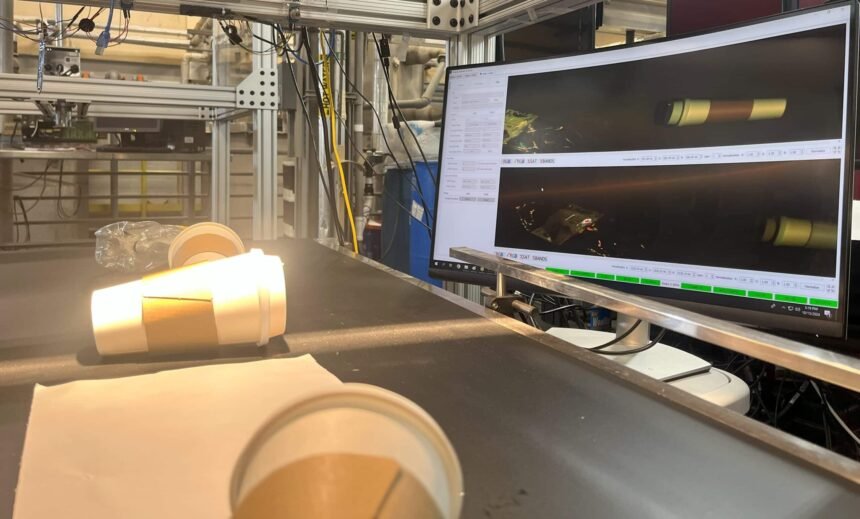
A recent investigation utilized hyperspectral imaging, a technique employing advanced optical sensors to capture the light spectrum across each pixel in an image. By scrutinizing how various materials reflect light, even beyond the visible spectrum, hyperspectral imaging generates distinct spectral “fingerprints” for each material. This enables swift identification of materials that may appear identical to the naked eye.
“Hyperspectral imaging serves as a potent tool that unveils what standard cameras or human eyes cannot see,” stated Lokendra Pal, E.J. Woody Rice Professor and University Faculty Scholar in the Department of Forest Biomaterials at North Carolina State University, and a co-author of the study.
“Through this technology, we can obtain real-time images of large waste quantities, delving into pixel-level data. By doing so, we can differentiate between various materials based on light reflection variations that are typically imperceptible,” Pal added.
The research, titled “Hyperspectral imaging for real-time waste materials characterization and recovery using endmember extraction and abundance detection,” has been published in Matter.
Hyperspectral imaging not only enables scientists to identify the type of material but also assess its quantity and potential contamination, making recycling processes more cost-effective and efficient, as highlighted by Pal.
Humans perceive light within the RGB spectrum, encompassing red, green, and blue. This spectrum consists of wavelengths ranging from approximately 400 to 700 nanometers, which determine color perception. Hyperspectral imaging, however, can capture wavelengths up to 2,500 nanometers, spanning the near-infrared and shortwave infrared ranges. This vast data collection can be utilized in tandem with machine learning to identify waste materials suitable for conversion into valuable products.