The collaboration involved Professor Francesca Santoro and Dr. Valeria Criscuolo from the Institute of Biological Information Processing—Bioelectronics at Forschungszentrum Jülich, working alongside colleagues from RWTH Aachen University—Professor Daniele Leonori and Junior Professor Giovanni Maria Piccini (currently at the University of Modena and Reggio Emilia).
The functionality of our brains is based on the transmission of signals between neurons, adapting and learning over time. Scientists are striving to replicate this neural behavior in electronic devices, an area known as neuromorphic electronics. One approach to achieving this goal is through the development of materials capable of “learning” in a manner akin to the human brain.
The team from Jülich and Aachen has made significant progress in this field. What sets their technology apart is its precise adjustability through chemical modifications. This feature enables the material to be customized for enhanced light sensitivity or signal stability, opening up a myriad of potential applications.
This versatile platform could function as an intermediary between technology and neural cells, facilitating applications in visual prostheses, medical devices, sensitive optical sensors, and advanced brain-machine interfaces. Moreover, the components boast low power consumption and adaptable properties to meet diverse needs.
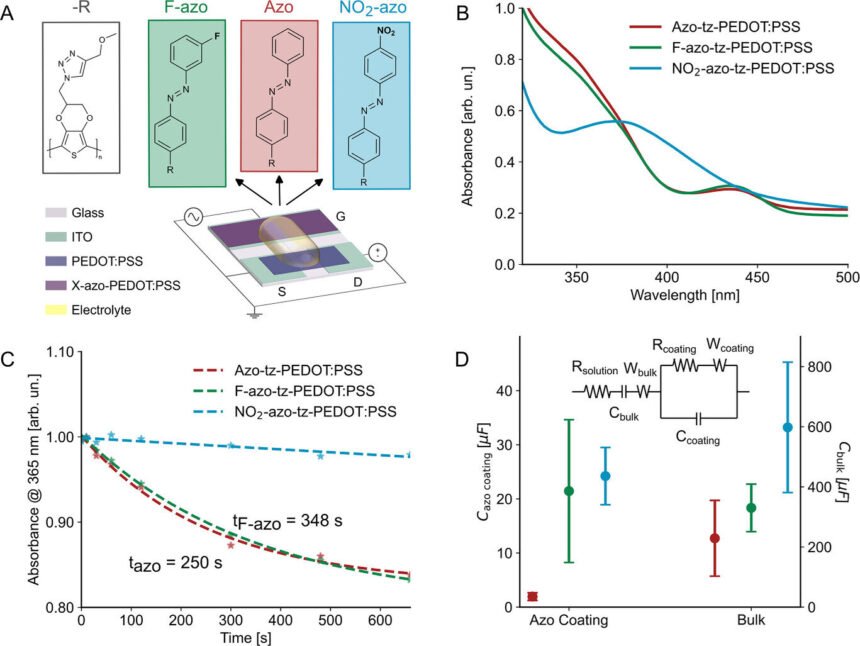
To ensure the future compatibility of the device with biological tissue, particularly nerve cells and eye tissue, the material must exhibit biocompatibility and operate effectively at body temperature. The researchers have integrated a specialized plastic called PEDOT:PSS, modified with light-sensitive molecules, which combines electrical conductivity with flexibility, making it ideal for interfacing electronics with biological systems.
This groundbreaking research holds promising implications for addressing retinal diseases and age-related visual impairments. However, rigorous testing on living tissue is essential before potential medical applications can be realized. The researchers conduct meticulous in vitro analyses, including assessments on nerve tissue, to validate the technology’s compatibility with biological systems.
For additional details, the study titled “Designing Light‐Sensitive Organic Semiconductors with Azobenzenes for Photoelectrochemical Transistors as Neuromorphic Platforms” by Isabela Berndt Paro et al. was published in Advanced Science in 2025 (DOI: 10.1002/advs.202509125).