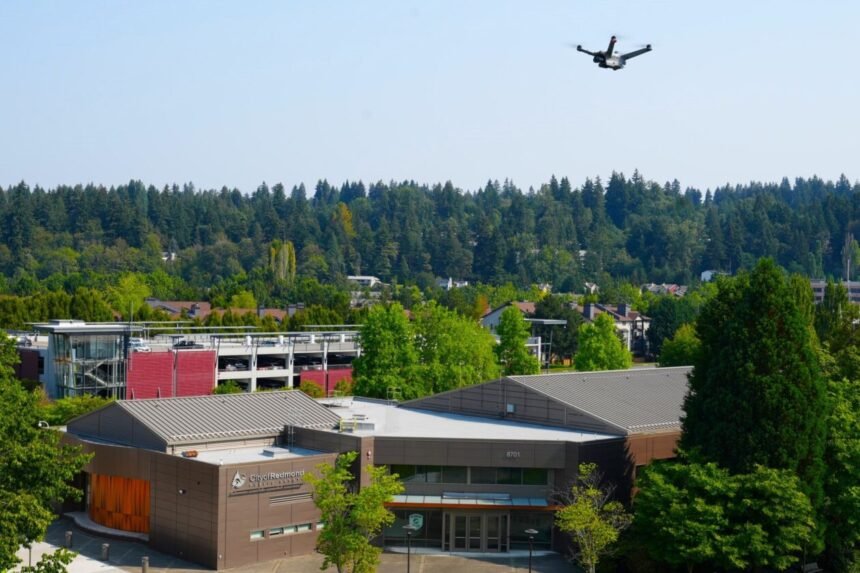
In the city that’s home to Microsoft, Redmond Police Chief Darrell Lowe isn’t just watching technological innovation from the sidelines — he’s integrating it into his department’s daily operations.
Lowe, a 30-year law enforcement veteran, views Redmond as the ideal staging ground for a new era of policing that capitalizes on advancements ranging from drones as first responders to artificial intelligence. When he became chief six years ago, his vision was to transform the department into a premier agency; technology has been a cornerstone of that mission.
“The public safety tech space is blowing up right now with a lot of interest and investment and VC money,” Lowe told GeekWire. “Being in Microsoft’s backyard doesn’t hurt, but it’s not like Microsoft is cutting checks for the Redmond Police Department.”
Lowe, who also runs his own public safety tech consultancy, primarily seeks tools that increase staff efficiency and simplify officer tasks. An AI-powered investigative platform from San Francisco-based Longeye fits that bill. Longeye ingests digital information such as surveillance video, phone records, crime scene photos and interviews to analyze data at speeds that exceed human review.
Lowe recently told KING 5 how the tool helped investigators confirm key evidence in a cold case by combing through 60 hours of jail phone calls in minutes.
However, he maintains that such tools are part of the equation rather than the total solution.
“It’s really important for law enforcement agencies and officers not to get lazy and think AI is the answer, because you still have to corroborate whatever that is,” Lowe said.
While AI is a newer addition to Lowe’s tech toolbox, the department has a history of technical adoption. Previous deployments included adhesive GPS trackers fired at cars to catch fleeing suspects and handheld narcotics analyzers that can scan through transparent packaging and identify more than 530 controlled substances, such as fentanyl, methamphetamine, and heroin.
But drones — specifically drones as first responders — are Lowe’s pride and joy. He equates their impact on modern policing to the era when handheld radios replaced police call boxes.
With a current staff of approximately 85 officers, Lowe employs two full-time drone pilots operating from a flight control center equipped with autonomous drones from Seattle-based Brinc and Skydio. Integrated directly into the department’s dispatch system, the drones can launch and arrive on-scene in under two minutes.
Lowe recalls a recent call regarding an individual experiencing a mental health crisis on a street corner. The person was screaming at the sky and waving his arms.
“Typical police response is you send an officer on the ground to make contact. We’ve seen those calls escalate and go wrong,” Lowe said.
Instead, a drone arrived in 30 seconds. From 250 feet, a pilot observed the individual, determined no crime was occurring and no one was in danger, and watched as the person eventually walked away.
“We canceled the ground unit response. There was no need for police contact,” Lowe said.
To address privacy concerns, Lowe implemented a “horizon-first” policy: drone cameras are pointed at the sky during transit and only tilt down once they reach the specific GPS coordinates of a call.

While drones have been a “game changer,” other technologies have hit speed bumps. The Redmond City Council recently paused the department’s license plate reader program following regional concerns about data sharing and whether U.S. Immigration and Customs Enforcement (ICE) could access the data.
Redmond PD started deploying Automated License Plate Readers (ALPRs) this summer to alert officers and analysts when a vehicle linked to a crime, missing person, stolen vehicle, or other critical incident is detected.
Lowe pushed back on what he calls “hysteria” surrounding the technology, arguing that cameras have a proven, valuable place in law enforcement.
“There is no expectation of privacy in a public place on a tax-funded road,” Lowe said, noting that Washington’s tolling cameras often capture more personal data (including driver faces) for longer periods than his ALPR systems. “The privacy concerns, while I understand they are legitimate, they also have to be balanced against what the law says.”
Because the City of Redmond signed a contract to launch the ALPR technology, Lowe noted that the council must now consider any legal ramifications of a potential breach of contract.
Reflecting on a long career that began in an innovative department in Santa Monica, Calif., under then-Chief Jim Butts, Lowe feels fortunate to have technology embedded in his “cop DNA.”
Now he laughs at how much the job description has evolved.
“When we all got into this, we wanted to go out there and catch bad guys … play cops and robbers and that whole thing,” he said. “I never imagined that I’d be negotiating multi-million-dollar, multi-year [tech] contracts as a cop.”
But even with modern advances, Lowe insists technology will never replace an officer’s empathy.
“We can never take the human out of the loop,” he said. “When people contact the police, it’s often not on their best day. It’s to have another human there to empathize and sympathize. It’s the reason why most of us got into this profession — to help others.”
The Importance of Mental Health Awareness in the Workplace
In recent years, there has been a growing recognition of the importance of mental health in the workplace. Employers are starting to realize that the mental well-being of their employees is just as important as their physical health. This shift in attitude is long overdue, as mental health issues can have a significant impact on both the individual and the organization as a whole.
One of the main reasons why mental health awareness in the workplace is so important is because mental health issues are incredibly common. According to the World Health Organization, depression and anxiety disorders are two of the most common mental health conditions worldwide. These conditions can have a major impact on an individual’s ability to perform their job effectively, leading to decreased productivity and increased absenteeism.
Furthermore, mental health issues can also have a negative impact on workplace relationships. A person who is struggling with their mental health may find it difficult to communicate effectively with their colleagues, leading to misunderstandings and conflicts. This can create a toxic work environment that is detrimental to the overall success of the organization.
By promoting mental health awareness in the workplace, employers can help to break down the stigma surrounding mental health issues. This can create a more supportive and understanding work environment where employees feel comfortable seeking help when they need it. Employers can also provide resources and support for employees who are struggling with their mental health, such as access to counseling services or mental health days.
In addition, promoting mental health awareness in the workplace can also have a positive impact on the bottom line. Research has shown that organizations that prioritize employee mental health have higher levels of employee engagement and retention. This is because employees feel valued and supported, leading to increased job satisfaction and loyalty.
Overall, mental health awareness in the workplace is crucial for creating a healthy and productive work environment. By prioritizing the mental well-being of employees, organizations can improve employee morale, productivity, and retention rates. It is essential for employers to recognize the importance of mental health and take steps to promote a culture of openness and support when it comes to mental health issues in the workplace.