

Saturday, 2 May 2026
Subscribe
logo logo
  • Global
  • Technology
  • Business
  • AI
  • Cloud
  • Edge Computing
  • Security
  • Investment
  • More
    • Sustainability
    • Colocation
    • Quantum Computing
    • Regulation & Policy
    • Infrastructure
    • Power & Cooling
    • Design
    • Innovations
  • 🔥
  • data
  • revolutionizing
  • Stock
  • Investment
  • Future
  • Secures
  • Growth
  • Top
  • Funding
  • Power
  • Center
  • technology
Font ResizerAa
Silicon FlashSilicon Flash
Search
  • Global
  • Technology
  • Business
  • AI
  • Cloud
  • Edge Computing
  • Security
  • Investment
  • More
    • Sustainability
    • Colocation
    • Quantum Computing
    • Regulation & Policy
    • Infrastructure
    • Power & Cooling
    • Design
    • Innovations
Have an existing account? Sign In
Follow US
© 2022 Foxiz News Network. Ruby Design Company. All Rights Reserved.
Silicon Flash > Blog > Innovations > The Power of Sound: How Loudness and Acoustic Cues Influence Speaker Orientation Perception
Innovations

The Power of Sound: How Loudness and Acoustic Cues Influence Speaker Orientation Perception

Published July 2, 2025 By Juwan Chacko
Share
5 Min Read
The Power of Sound: How Loudness and Acoustic Cues Influence Speaker Orientation Perception
SHARE
As our digital world continues to evolve, the way we perceive directional audio in virtual environments becomes increasingly crucial. The latest breakthrough in spatial audio research, conducted by experts at Sophia University in Japan, sheds light on how humans identify a speaker’s facing direction using a combination of loudness and frequency-based acoustic cues. This discovery has profound implications for the development of immersive technologies like augmented reality (AR) and virtual reality (VR), enhancing the user experience in virtual soundscapes. Dive into the details of this groundbreaking study to uncover the fascinating relationship between sound perception and spatial awareness.

Understanding Directional Audio in Virtual Environments

As technology increasingly integrates complex soundscapes into virtual spaces, understanding how humans perceive directional audio becomes vital. This need is bolstered by the rise of immersive media, such as augmented reality (AR) and virtual reality (VR), where users are virtually transported into other worlds. In a recent study, researchers explored how listeners identify the direction from which a speaker is facing while speaking.

Groundbreaking Research by Sophia University Experts

The research was led by Dr. Shinya Tsuji, a postdoctoral fellow, Ms. Haruna Kashima, and Professor Takayuki Arai from the Department of Information and Communication Sciences, Sophia University, Japan. The team also included Dr. Takehiro Sugimoto, Mr. Kotaro Kinoshita, and Mr. Yasushige Nakayama from the NHK Science and Technology Research Laboratories, Japan. Their study was published in the journal Acoustical Science and Technology.

Key Findings on Loudness and Spectral Cues

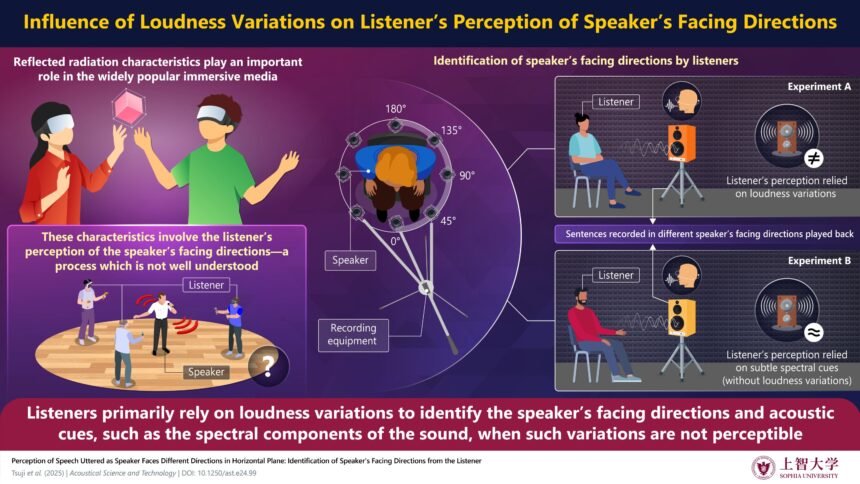
In the study, the researchers asked participants to identify the direction a speaker was facing using only sound recordings, using two experiments. The first experiment involved sound recordings with variations in loudness, and the second experiment involved recordings with constant loudness.

See also  Secure Access: Biometric Passwordless Login and EU Digital Wallet Protection Platform

The researchers found that loudness was consistently a strong indicator in judging the speaker’s facing direction, but when loudness cues were minimized, listeners still managed to make correct judgments based on the spectral cues of the sound. These spectral cues involve the distribution and quality of sound frequencies that change subtly depending on the speaker’s orientation.

Implications for Immersive Audio Technologies

These findings are particularly useful in virtual sound fields that allow six-degrees-of-freedom—immersive environments like those found in AR and VR applications, where users can move freely and experience audio in different spatial configurations.

“In contents having virtual sound fields with six-degrees-of-freedom—like AR and VR—where listeners can freely appreciate sounds from various positions, the experience of human voices can be significantly enhanced using the findings from our research,” said Dr. Tsuji.

Future Applications and Industry Impact

The research emerges at a time when immersive audio is a major design frontier for consumer tech companies. Devices such as Meta Quest 3 and Apple Vision Pro are already shifting how people interact with digital spaces. Accurate rendering of human voices in these environments can significantly elevate user experience—whether in entertainment, education, or communication.

“AR and VR have become common with advances in technology,” Dr. Tsuji added. “As more content is developed for these devices in the future, the findings of our study may contribute to such fields.”

Enhancing Realism and User Experience

Beyond the immediate applications, this research has broader implications in how we might build more intuitive and responsive soundscapes in the digital world. By improving realism through audio, companies can create more convincing immersive media—an important factor not only for entertainment, but also for accessibility solutions, virtual meetings, and therapeutic interventions.

See also  Nextchip taps Ceva’s edge AI NPU to power smarter, safer ADAS systems

By uncovering the role of both loudness and spectral cues in voice-based directionality, this study deepens our understanding of auditory perception and lays a foundation for the next generation of spatial audio systems. The findings pave the way for designing more realistic virtual interactions, particularly those involving human speech, which is probably the most familiar and meaningful sound we process every day.

Conclusion

With the groundbreaking research on directional audio perception in virtual environments, the team from Sophia University has opened new possibilities for enhancing spatial audio experiences in immersive technologies. By combining insights on loudness and spectral cues, this study not only advances our understanding of human sound perception but also paves the way for innovative developments in AR, VR, and beyond.

TAGGED: Acoustic, Cues, Influence, Loudness, Orientation, Perception, Power, sound, Speaker
Share This Article
Facebook LinkedIn Email Copy Link Print
Previous Article R0AR Token Roars onto MEXC Exchange: A Game-Changer for DeFi Accessibility R0AR Token Roars onto MEXC Exchange: A Game-Changer for DeFi Accessibility
Next Article Field Medical Secures M in Series B Funding Round Field Medical Secures $35M in Series B Funding Round
Leave a comment

Leave a Reply Cancel reply

Your email address will not be published. Required fields are marked *

Your Trusted Source for Accurate and Timely Updates!

Our commitment to accuracy, impartiality, and delivering breaking news as it happens has earned us the trust of a vast audience. Stay ahead with real-time updates on the latest events, trends.
FacebookLike
LinkedInFollow

Popular Posts

Breaking Ground: Blykalla, Evroc, and Studsvik Collaborate on Sweden’s Pioneering Nuclear Data Centers

Summary: 1. Sweden is moving closer to establishing Europe's first generation of nuclear-powered data centers…

October 8, 2025

Revolutionizing Real-Time Video Generation: Decart’s Cutting-Edge Use of AWS Trainium3

Summary: 1. Amazon Web Services partners with AI video startup Decart to optimize its Lucy…

December 6, 2025

Comparing Consumer Staples ETFs: XLP vs. RSPS – Which One Should You Invest In?

XLP and RSPS are both ETFs that focus on the U.S. consumer staples sector. XLP…

November 14, 2025

Evolution of Immersion Cooling: Transforming Data Centers into Essential hubs

Summary: 1. Immersion cooling is no longer a niche technology but a necessity due to…

August 13, 2025

Seagate’s £115m R&D Investment in Northern Ireland: A Game-Changer for Innovation

Seagate Invests £115 Million in Nano-Photonic Research and Development Seagate has recently announced a substantial…

September 11, 2025

You Might Also Like

Empowering Innovation: The Role of Design Enablement Teams in the European Chips Act
Innovations

Empowering Innovation: The Role of Design Enablement Teams in the European Chips Act

Juwan Chacko
Secure Access: Biometric Passwordless Login and EU Digital Wallet Protection Platform
Innovations

Secure Access: Biometric Passwordless Login and EU Digital Wallet Protection Platform

Juwan Chacko
The Crucial Role of Intelligent Networks in Europe’s Digital Future
Innovations

The Crucial Role of Intelligent Networks in Europe’s Digital Future

Juwan Chacko
Revolutionizing Data Centers: The Shift to 800VDC Power Architectures
Power & Cooling

Revolutionizing Data Centers: The Shift to 800VDC Power Architectures

Juwan Chacko
logo logo
Facebook Linkedin Rss

About US

Silicon Flash: Stay informed with the latest Tech News, Innovations, Gadgets, AI, Data Center, and Industry trends from around the world—all in one place.

Top Categories
  • Technology
  • Business
  • Innovations
  • Investments
Usefull Links
  • Home
  • Contact
  • Privacy Policy
  • Terms & Conditions

© 2025 – siliconflash.com – All rights reserved

Welcome Back!

Sign in to your account

Lost your password?