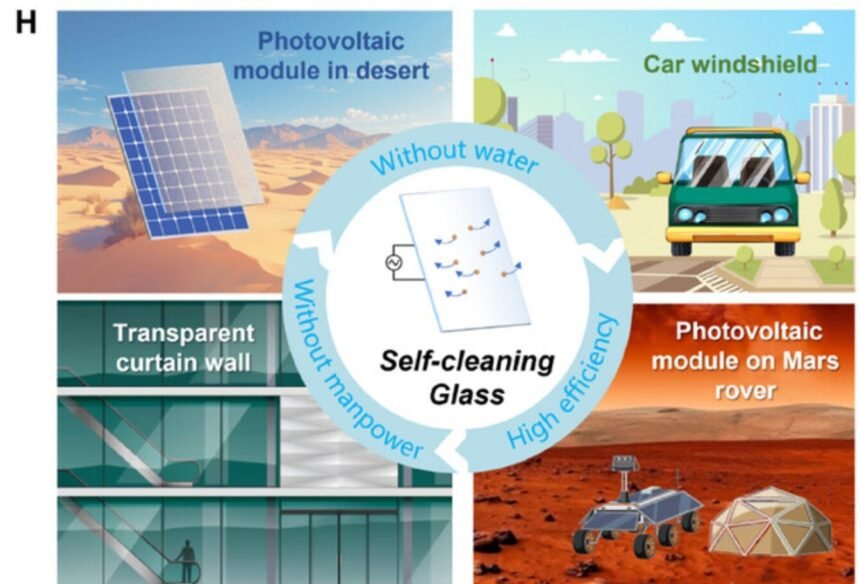
What if windows could clean themselves at the flick of a switch? We’re not quite there yet, but we are getting closer. Scientists have created a transparent, easy-to-produce self-cleaning glass that can remove particles in just 10 seconds using an electric field. This innovative solution offers a water-free and sustainable alternative to traditional cleaning methods that can be applied to not only terrestrial vehicles and buildings but also solar panels on probes driving across the surface of Mars. According to the findings, published in Advanced Science, glass was able to achieve self-cleaning of both organic and inorganic particles and showed self-cleaning efficiency of more than 95% within seconds.
Dust is everywhere and always finds a way to settle onto surfaces, no matter how many times you clean them. Geological and biological sources along with anthropogenic sources create surface particle pollution that can reduce the visibility of window panels and the performance of photovoltaic cells. The conventional water and detergent cleaning method is resource-intensive and environmentally polluting. Nature has examples of self-cleaning surfaces, and scientists have mimicked these properties to create self-cleaning surfaces. However, their efficacy relies on weather conditions like humidity. Electrostatic methods have shown promise in removing airborne particles, but they struggle with particles that are clung to a surface.
The transparent, coverable self-cleaning glass designed by researchers overcame existing problems and exhibited exceptional particle removal efficiency. The glass featured a sandwich-like structure with various layers, and it demonstrated the ability to remove particles with high efficiency using an electric field. The researchers believe that understanding how particles move and detach under electric fields is crucial for developing self-cleaning surfaces that function well in waterless and harsh conditions on Earth and in outer space.
With the help of experimental observation and theoretical modeling, the researchers investigated the mechanisms behind particle movement under an applied electric field. The study presented a self-cleaning glass that can be applied to a wide range of surfaces without interfering with its original function or light transmittance, offering a sustainable and chemical-free cleaning process. The development of this self-cleaning glass opens up new possibilities for maintaining cleanliness in various environments.