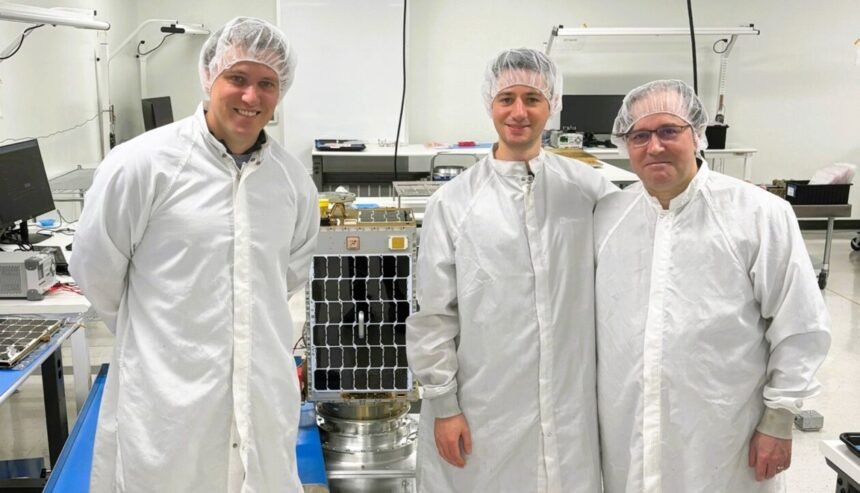
Starcloud, a Seattle-area startup, is making waves in the space-based AI industry with its innovative approach to providing data center services in orbit. Founded by CEO Philip Johnston, chief technology officer Ezra Feilden, and chief engineer Adi Oltean, the company is revolutionizing the way artificial intelligence applications are processed in space.
Instead of managing the data processing chips themselves, Starcloud offers a unique solution – a solar-powered satellite equipped with cooling and communication hardware, which its partners can use to operate their own data processing chips. This model allows Starcloud to provide the infrastructure while its partners supply the processing power, saving costs on expensive chips.
One of Starcloud’s key partnerships is with Denver-based Crusoe Cloud, a strategic partner that has signed a contract with Starcloud for 10 gigawatts of power from 2032 for five years at 3 cents per kilowatt-hour, totaling $13.1 billion worth of energy. This arrangement positions Starcloud as a major player in the space utility market.
Starcloud’s first major achievement was the successful launch of its Starcloud-1 satellite, equipped with an Nvidia H100 chip. This satellite demonstrated the capability to process AI data reliably in the harsh radiation environment of space. With this milestone, Starcloud proved that orbital data centers can be a viable solution for processing AI data.
Following the success of Starcloud-1, the company is gearing up for more ambitious projects. Starcloud-2 is set to launch next October with increased power-generating capabilities and advanced chips from Nvidia. The company envisions scaling up to Starcloud-3, a 2-ton spacecraft with a 100-kilowatt capacity, launching a constellation of tens of thousands of satellites in low Earth orbit.
This constellation, known as Starcloud-3, will feature satellites traveling in a globe-girdling train, with data transmitted via laser links between satellites. The company is in the process of seeking a license from the Federal Communications Commission for this groundbreaking project.
With its innovative approach to space-based AI and data center services, Starcloud is poised to revolutionize the industry and carve out a significant presence in the growing market for orbital data processing.
Starcloud’s funding and growth plans are contingent on SpaceX’s progress with the Starship super-rocket for satellite deployment. The company has raised $34 million and is considering a Series A funding round in 2026 to support future projects. With a team of 12 members, Starcloud is looking to expand and relocate to a larger facility in Redmond. Industry interest in orbital data centers has increased, with SpaceX and Blue Origin’s involvement settling debates about their value proposition.
Johnston believes Starcloud has a competitive advantage against industry giants like Google and SpaceX, citing Google’s Project Suncatcher as a similar initiative. Starcloud’s technology and capabilities give it a head start in the market, positioning it as a potential partner for industry leaders. The company aims to place satellites in various orbits, including lunar orbits and Lagrangian points, for enhanced performance beyond low Earth orbit.