

Sunday, 12 Apr 2026
Subscribe
logo logo
  • Global
  • Technology
  • Business
  • AI
  • Cloud
  • Edge Computing
  • Security
  • Investment
  • More
    • Sustainability
    • Colocation
    • Quantum Computing
    • Regulation & Policy
    • Infrastructure
    • Power & Cooling
    • Design
    • Innovations
  • 🔥
  • data
  • revolutionizing
  • Stock
  • Investment
  • Future
  • Secures
  • Growth
  • Top
  • Funding
  • Power
  • Center
  • technology
Font ResizerAa
Silicon FlashSilicon Flash
Search
  • Global
  • Technology
  • Business
  • AI
  • Cloud
  • Edge Computing
  • Security
  • Investment
  • More
    • Sustainability
    • Colocation
    • Quantum Computing
    • Regulation & Policy
    • Infrastructure
    • Power & Cooling
    • Design
    • Innovations
Have an existing account? Sign In
Follow US
© 2022 Foxiz News Network. Ruby Design Company. All Rights Reserved.
Silicon Flash > Blog > Innovations > Adaptive Origami: Engineers Create Structures with Shape-Shifting Abilities
Innovations

Adaptive Origami: Engineers Create Structures with Shape-Shifting Abilities

Published September 6, 2025 By Juwan Chacko
Share
3 Min Read
Adaptive Origami: Engineers Create Structures with Shape-Shifting Abilities
SHARE
Princeton University engineers are experimenting with innovative origami techniques to create structures that can adapt and transform in response to changing conditions. This new approach has the potential to revolutionize the design of prosthetics, antennas, and various other devices.

Princeton engineers are twisting, stretching, and creasing structures in a unique way to create a new form of origami that can alter its shape and properties based on external stimuli. This groundbreaking method holds promise for applications in prosthetics, antennas, and other technological devices.

When faced with the challenge of fitting a device into a confined space, such as a spacecraft or a medical instrument, and then unfolding it into a complex shape, origami has often been the go-to solution. However, traditional origami designs are typically limited to a set number of patterns once the folds are made.

A team of researchers at Princeton, led by Glaucio Paulino, aimed to develop structures that could respond to external stimuli in a more versatile manner, rather than being restricted to predetermined responses. To achieve this goal, the team turned to a concept known as geometric frustration.

Geometric frustration involves preventing an origami-based structure from naturally folding and twisting in certain ways based on its material properties and geometry. By introducing this “frustration,” engineers can expand their design possibilities and create structures that exhibit unconventional behaviors.

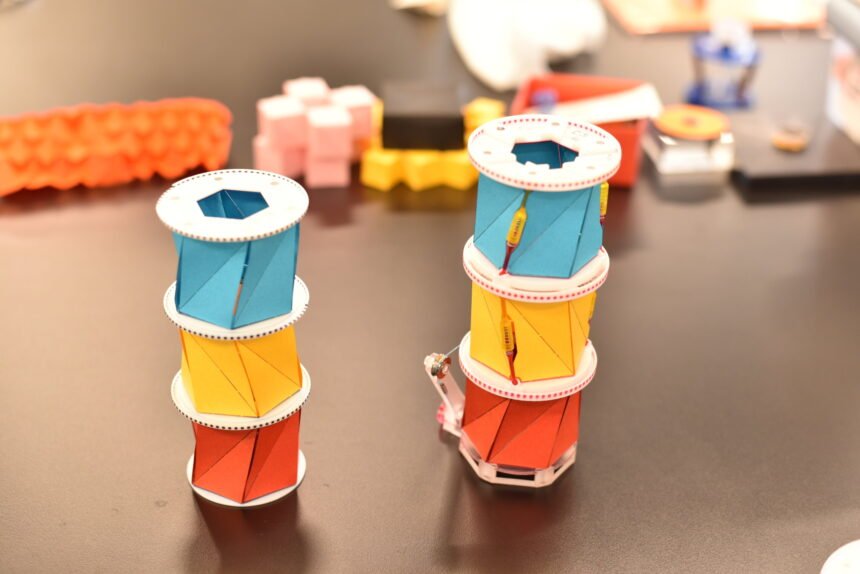
In a recent publication in the Proceedings of the National Academy of Sciences, the researchers detailed how they integrated elastic components into cylindrical origami structures called Kresling cells. These elastic elements function like springs, allowing for precise control over the folding patterns of the cells that would not be achievable with traditional materials alone.

See also  Autonomous Soft Robots: Emerging from the 3D Printer

By strategically incorporating springs into the origami structures, designers can introduce internal energy through pre-stress, enabling the structures to exhibit unique responses. For instance, engineers can implement twisting springs to induce specific rotations or utilize axial springs to compress or elongate the structure.

Through the combination of frustrated cells in stacked arrangements, the researchers were able to develop materials with finely tuned properties like stiffness. This innovative approach opens up a myriad of possibilities, such as creating prosthetic limbs that can adjust their stiffness for different activities or designing adaptable metasurfaces for antennas and optics.

The team envisions a wide range of potential applications for this novel origami system across various industries. By integrating frustrated origami with dynamic materials and techniques, designers can create responsive and modular devices that can adapt to changing conditions, offering unparalleled flexibility and versatility in engineering solutions.


TAGGED: Abilities, Adaptive, create, Engineers, Origami, ShapeShifting, Structures
Share This Article
Facebook LinkedIn Email Copy Link Print
Previous Article Next-Gen AI Solutions: Cisco, Nvidia, and VAST Team Up for Turnkey Infrastructure Components Next-Gen AI Solutions: Cisco, Nvidia, and VAST Team Up for Turnkey Infrastructure Components
Next Article Revolutionizing Data Centers: Nvidia Introduces Blackwell GPUs for Enterprise Use Revolutionizing Data Centers: Nvidia Introduces Blackwell GPUs for Enterprise Use
Leave a comment

Leave a Reply Cancel reply

Your email address will not be published. Required fields are marked *

Your Trusted Source for Accurate and Timely Updates!

Our commitment to accuracy, impartiality, and delivering breaking news as it happens has earned us the trust of a vast audience. Stay ahead with real-time updates on the latest events, trends.
FacebookLike
LinkedInFollow

Popular Posts

Exterra Carbon Solutions Secures CAD$20M in Series A Financing

Summary: Exterra Carbon Solutions, a cleantech company based in Montreal, closed a CAD $20m Series…

May 13, 2025

Enhanced Networking Features in Kubernetes v1.34 for Cloud-Native Infrastructure

In the realm of Kubernetes networking, KEP #3015, titled 'PreferSameZone and PreferSameNode Traffic Distribution,' aims…

August 29, 2025

Stocks Set for Another Year of Stellar Returns: Is a Fourth on the Horizon?

In 2026, the S&P 500 is expected to see more subdued gains after three consecutive…

December 28, 2025

Revolutionizing Communication: Le Chat’s Voice Recognition and Advanced Research Capabilities with Mistral AI

Summary: Mistral AI has updated Le Chat with voice recognition, deep research tools, and other…

July 17, 2025

Crabi Secures $13.6M in Investment Capital

Summary: Crabi, a Mexico City-based auto insurance platform, secured $13.6M in funding led by Kaszek…

June 8, 2025

You Might Also Like

Empowering Innovation: The Role of Design Enablement Teams in the European Chips Act
Innovations

Empowering Innovation: The Role of Design Enablement Teams in the European Chips Act

Juwan Chacko
Secure Access: Biometric Passwordless Login and EU Digital Wallet Protection Platform
Innovations

Secure Access: Biometric Passwordless Login and EU Digital Wallet Protection Platform

Juwan Chacko
The Crucial Role of Intelligent Networks in Europe’s Digital Future
Innovations

The Crucial Role of Intelligent Networks in Europe’s Digital Future

Juwan Chacko
Innovating the Future: EPI’s Revolutionary Approach to High-Performance Computing
Innovations

Innovating the Future: EPI’s Revolutionary Approach to High-Performance Computing

Juwan Chacko
logo logo
Facebook Linkedin Rss

About US

Silicon Flash: Stay informed with the latest Tech News, Innovations, Gadgets, AI, Data Center, and Industry trends from around the world—all in one place.

Top Categories
  • Technology
  • Business
  • Innovations
  • Investments
Usefull Links
  • Home
  • Contact
  • Privacy Policy
  • Terms & Conditions

© 2025 – siliconflash.com – All rights reserved

Welcome Back!

Sign in to your account

Lost your password?