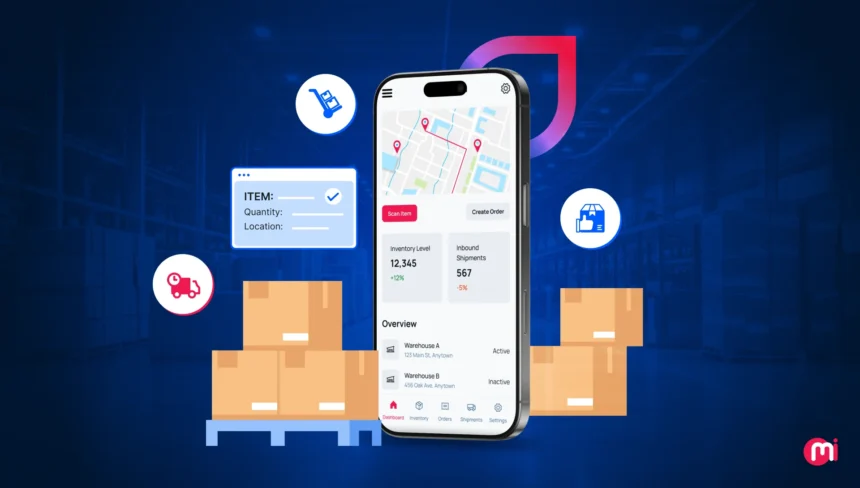
Warehouse management systems play a crucial role in enhancing business performance by ensuring efficiency in warehouse operations. This article delves into the step-by-step process of developing warehouse management software, covering essential features, development strategies, challenges, solutions, costs, and other significant factors.
Key Takeaways
- A Warehouse Management System (WMS) is a digital platform that efficiently manages warehouse operations, inventory, and order fulfillment.
- There are four main types of WMS: stand-alone, ERP-integrated, cloud-based, and industry-specific, each serving different operational goals.
- Building a custom WMS provides control, precision, and performance, aligning warehouse processes with the business model.
- Efficient WMS balance everyday operational tools with high-level tech like automation, IoT, and data analytics.
- Developing an efficient WMS involves a strategic process, from understanding needs to design, integration, testing, and optimization.
- Challenges like integration complexity, adoption issues, or scalability concerns can be addressed through modular design and proactive maintenance.
- Costs for WMS development can range from $35,000 for a simple setup to $250,000+ for a high-end system, with a promising ROI.
- The future of warehouse management is driven by AI, robotics, and real-time intelligence, transforming warehouses into smart, self-optimizing ecosystems.
What is Warehouse Management Software?
Warehouse Management Software (WMS) is a system that oversees and coordinates all warehouse activities and processes, from receiving and putaway to picking, packing, and shipping. It ensures accurate monitoring and efficient direction of goods within the warehouse.
Summary: This article explores the development of warehouse management software, highlighting key features, challenges, and future trends to enhance operational efficiency.