

Monday, 22 Dec 2025
Subscribe
logo logo
  • Global
  • Technology
  • Business
  • AI
  • Cloud
  • Edge Computing
  • Security
  • Investment
  • More
    • Sustainability
    • Colocation
    • Quantum Computing
    • Regulation & Policy
    • Infrastructure
    • Power & Cooling
    • Design
    • Innovations
  • 🔥
  • data
  • revolutionizing
  • Secures
  • Investment
  • Future
  • Stock
  • Funding
  • Growth
  • Center
  • Power
  • technology
  • Top
Font ResizerAa
Silicon FlashSilicon Flash
Search
  • Global
  • Technology
  • Business
  • AI
  • Cloud
  • Edge Computing
  • Security
  • Investment
  • More
    • Sustainability
    • Colocation
    • Quantum Computing
    • Regulation & Policy
    • Infrastructure
    • Power & Cooling
    • Design
    • Innovations
Have an existing account? Sign In
Follow US
© 2022 Foxiz News Network. Ruby Design Company. All Rights Reserved.
Silicon Flash > Blog > Innovations > Enhancing Wearable Biosensors with Conductive Polymer Technology
Innovations

Enhancing Wearable Biosensors with Conductive Polymer Technology

Published July 7, 2025 By Juwan Chacko
Share
2 Min Read
Enhancing Wearable Biosensors with Conductive Polymer Technology
SHARE

Creating flexible, biocompatible, and electrically conductive materials for wearable biosensors is a challenging task. Researchers at the Max Planck Institute for Polymer Research have developed an innovative method to enhance the properties of the conductive polymer PEDOT:PSS, making it more stretchable and electrically conductive.


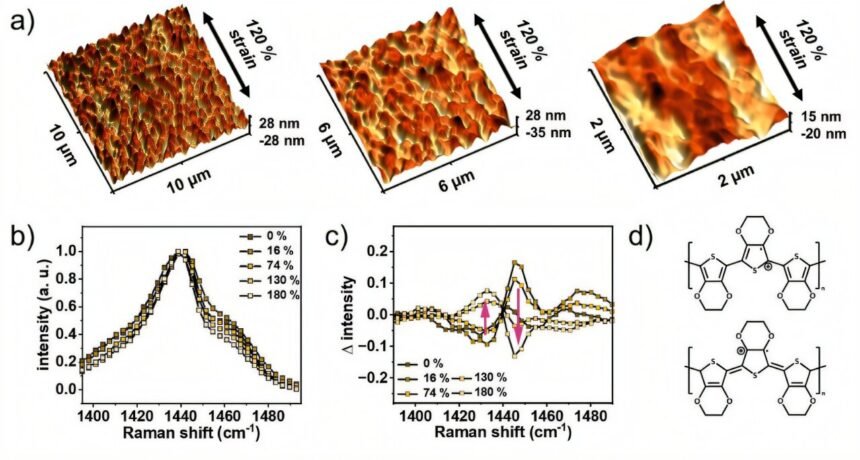
Properties of strained PEDOT:PSS thin films. Credit: Advanced Science (2025). DOI: 10.1002/advs.202502853

When aiming for stretchable, health-monitoring, skin-like sensor sheets, materials with demanding properties are required: they need to be flexible, biocompatible, and electrically conductive at the same time.

A research team at the Max Planck Institute for Polymer Research is tackling this complex task. In a recent study, the scientists present an innovative approach: using a transfer-printing process, the conductive polymer PEDOT:PSS is modified via plasticizers that diffuse from the substrate into the polymer film. This significantly improves both the electrical conductivity and the stretchability of the material.

The research results have been published in the journal Advanced Science.

A deformable patch that measures the heart rate or detects biomarkers in the sweat and feels as soft and flexible as one’s own skin—such visions demand new material developments.

To realize ideas like these, as well as wearable and skin-like electronics in general, materials that possess both high electrical conductivity and mechanical stretchability are required.

A team of scientists at the Max Planck Institute for Polymer Research led by Dr. Ulrike Kraft is currently working on this challenge. However, stretchability and electrical conductivity are often contradictory, which complicates the development of suitable materials, explains Ulrike Kraft, head of the Organic Bioelectronics Research Group.

See also  Revolutionizing Disaster Response: AI Technology Converts Drone Images into Real-Time Disaster Area Maps
TAGGED: Biosensors, Conductive, Enhancing, Polymer, technology, wearable
Share This Article
Facebook LinkedIn Email Copy Link Print
Previous Article Enhancing Edge Inference: Breaking AI’s Storage Barrier Enhancing Edge Inference: Breaking AI’s Storage Barrier
Next Article The Evolution of Data Center Capacity: A Focus on Hyperscalers The Evolution of Data Center Capacity: A Focus on Hyperscalers
Leave a comment

Leave a Reply Cancel reply

Your email address will not be published. Required fields are marked *

Your Trusted Source for Accurate and Timely Updates!

Our commitment to accuracy, impartiality, and delivering breaking news as it happens has earned us the trust of a vast audience. Stay ahead with real-time updates on the latest events, trends.
FacebookLike
LinkedInFollow

Popular Posts

Revolutionizing The Kingdom: A Showcase of Digital Transformation at Smart Data & AI Summit

Summary: 1. The Smart Data & AI Summit in Saudi Arabia will help shape the…

June 6, 2025

The Dangers of Relying on the Martingale Trading Strategy

Summary: 1. The Martingale system, originally designed for 18th-century gaming, has made its way into…

May 17, 2025

The Impact of Regulatory Policies on Renewable Energy Adoption in Data Centers

Data Center Energy Demand: A Rapid Evolution in the Power Sector In a recent episode…

May 8, 2025

Q.ANT Secures €62M Funding to Revolutionize Photonic AI and HPC Processors

Q.ANT, a leading player in photonic processing based in Germany, has successfully secured €62 million…

July 24, 2025

Unleashing the Power of AI: The Supercharged Company Poised for a Trillion-Dollar IPO

The artificial intelligence (AI) industry has been dominating the stock market for quite some time…

November 12, 2025

You Might Also Like

Future Trends in Data Collection: A Look into 2026 and Beyond
Innovations

Future Trends in Data Collection: A Look into 2026 and Beyond

Juwan Chacko

Revolutionizing Cloud Technology: Exploring Alternative Cloud Solutions for a Dynamic Future

Juwan Chacko
Revolutionizing AI Data Centers: The Impact of Airsys’ Spray Cooling Technology
Global Market

Revolutionizing AI Data Centers: The Impact of Airsys’ Spray Cooling Technology

Juwan Chacko
Pauling.AI: Revolutionizing Drug Discovery with Scientist-as-a-Service Technology
Business

Pauling.AI: Revolutionizing Drug Discovery with Scientist-as-a-Service Technology

Juwan Chacko
logo logo
Facebook Linkedin Rss

About US

Silicon Flash: Stay informed with the latest Tech News, Innovations, Gadgets, AI, Data Center, and Industry trends from around the world—all in one place.

Top Categories
  • Technology
  • Business
  • Innovations
  • Investments
Usefull Links
  • Home
  • Contact
  • Privacy Policy
  • Terms & Conditions

© 2025 – siliconflash.com – All rights reserved

Welcome Back!

Sign in to your account

Lost your password?