The efficiency of your software development solution is not solely determined by the speed of its launch. Rather, it hinges on the intelligent design for scalability, security, and maintainability.
While the software developed may perform adequately, as it grows, the codebase can become intricate, and even minor updates can disrupt core functionalities. In this scenario, it’s not just about coding; it’s also about the software architecture.
This is where software design patterns come into play. They present proven, reusable solutions to recurring design dilemmas, assisting teams in constructing systems that are not only functional but also adaptable, maintainable, and scalable.
Therefore, for CTOs and tech leads, comprehending these software design patterns is imperative.
Whether you are revamping a legacy platform or devising a new microservices architecture, selecting the right design pattern can significantly reduce complexity and technical debt. The correct choice also enhances developer collaboration.
This article dissects the three primary categories of software design patterns: Creational, Structural, and Behavioral, elucidating how each contributes to the development of high-quality, future-proof software systems.
Key Takeaways
- Software design patterns encompass creational, structural, and behavioral patterns.
- Creational patterns simplify object creation and foster uniformity.
- Structural patterns enhance modularity and streamline system integration.
- Behavioral patterns enhance communication, control flow, and adaptability.
- Strategic application of patterns facilitates the development of cleaner, future-proof software.
What Are Software Design Patterns?
A software design pattern serves as a reusable, verified solution to common design challenges encountered by developers during the construction or structuring of software systems. In simple terms, it functions as a blueprint, aiding developers in organizing software code more effectively.
From a business standpoint, patterns ensure consistency, scalability, and expedited development cycles, particularly in extensive projects where multiple teams contribute to the same software design system. They bridge the gap between software architecture design and code implementation, aligning technical excellence with long-term maintainability.
Also Read: Software Design Principles
Why Do Software Design Patterns Matter?
The utilization of software design patterns is crucial as they furnish reusable solutions, enhance code quality, foster collaboration, and bolster maintainability. Other benefits encompass heightened flexibility and scalability, reduced coupling, and simplified complexity.
Let’s delve into the top reasons why software design patterns hold significance:
- Software design patterns offer tested and validated solutions to recurrent issues in software design, thereby saving time and effort compared to crafting a solution from scratch.
- They endow developers with a standardized and well-structured format for crafting robust and dependable code for common issues.
- Design patterns furnish developers with a common language to succinctly communicate intricate design concepts, thereby enhancing collaboration and expediting development while curbing misunderstandings between teams.
- A structured coding pattern empowers developers to generate more readable and maintainable code that can be comprehended easily by other developers. This also diminishes the necessity for extensive documentation.
- It grants developers access to adaptable frameworks, thereby simplifying adaptation to evolving requirements and integration of new features sans a major system overhaul.
- Patterns aid in mitigating issues like tight coupling that render a system inflexible and hard to maintain.
Key Characteristics of Software Design Patterns
The key characteristics of software design patterns encompass being proven solutions to common problems, fostering code reusability and maintainability, establishing a common vocabulary for developers, and providing a flexible and scalable structure.
These patterns abstract away implementation specifics to concentrate on high-level design, thereby enhancing efficiency, collaboration, and the overall quality of the software.
Let’s delve deeper into the key characteristics of software design patterns:
1. Reusability
Software design patterns are devised to be applied repeatedly across diverse projects and scenarios. They encapsulate best practices so that teams need not reinvent solutions for recurrent design dilemmas.
2. Scalability
Well-executed design patterns in software design render your system adaptable to expansion. Whether you are incorporating new modules, integrating APIs, or expanding user traffic, the architecture can evolve sans major rewrites.
3. Maintainability
Patterns advocate for clean separation of concerns, implying that each module or class possesses a clear, focused responsibility. This simplifies debugging, testing, and updating the system as it progresses.
4. Standardized Communication
They furnish a common vocabulary among developers, architects, and business teams. Instead of lengthy technical explanations, one can simply state, “Let’s utilize a Singleton here,” and everyone comprehends the intent.
5. Abstraction Over Implementation
Design patterns focus on how components ought to interact, not how they are coded. This level of abstraction fosters design thinking, marking the software teams as mature and future-ready.

Different Types of Software Design Patterns
There exist primarily three kinds of software design patterns: creational, structural, and behavioral. Let’s peruse a list of software design patterns:
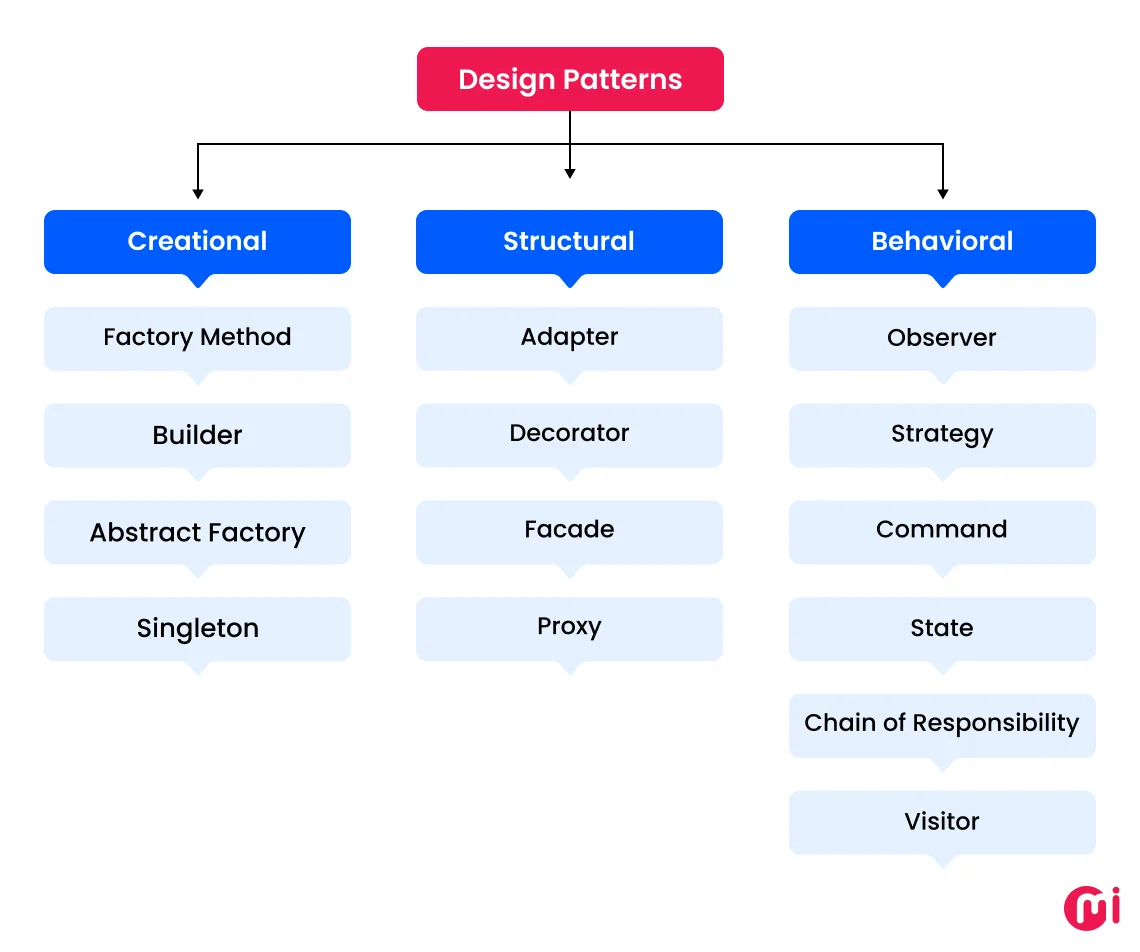
1. Creational Design Patterns
Creational patterns are among the prevalent software design patterns that concentrate on how objects are instantiated. Instead of directly creating classes, they furnish flexible object-creation mechanisms that render systems easier to scale and maintain.
Singleton Pattern
The singleton software design pattern ensures a class possesses only one instance and provides a universal point of access to it. Being a segment of the creational pattern, it governs object creation while thwarting other parts of the code from generating new instances.
This pattern proves useful for managing shared resources like a database connection or a logging service, where only one instance is requisite for efficiency and consistency.
Factory Method Pattern
The factory method furnishes an interface for crafting objects in a superclass while permitting subclasses to modify the type of objects that will be crafted. It advocates loose coupling by decoupling the client-side code from the concrete classes it instantiates.
Builder Pattern
The builder method segregates the construction of a complex object from its representation, enabling the same process to create diverse variations of the object. It adopts a step-by-step approach, providing a builder class with methods to construct different parts of the object, frequently culminating with a final build() method to return the complete object.
This methodology sidesteps lengthy constructors and parameter lists, rendering code more readable and maintainable, particularly when objects encompass numerous optional components.
It empowers developers to isolate the intricate object construction logic from the business logic of the product, garner greater control over the construction process, craft diverse representations of the same object, and render object creation code more lucid.
Abstract Factory Method Pattern
The abstract factory method pattern affords an interface to generate families of related or dependent objects sans specifying their precise classes. In simpler terms, it enables you to produce objects that belong to a specific “theme” or “family,” ensuring that products created together are compatible.
It is ideal to employ this pattern when your system necessitates independence from how its products are created or when you need to ensure consistency amid related objects. Consequently, it promotes scalability and consistency by encapsulating object creation logic, making it simpler to switch product families sans altering existing code.
Prototype Method Pattern
The prototype method pattern enables you to create novel objects by cloning existing ones, rather than constructing them from scratch. It is especially advantageous when the cost of creating an object is high, such as when it encompasses complex initialization, database calls, or extensive configuration.
As a result, it enhances performance and flexibility by reducing the overhead of object creation and permitting dynamic object customization at runtime.
Also Read: Effective Software Development Best Practices
2. Structural Design Patterns
Structural patterns focus on how classes and objects are structured to form larger, more flexible structures. They assist in simplifying relationships and reducing system complexity.
Adapter Pattern
The adapter pattern functions as a bridge between incompatible interfaces, enabling classes that would otherwise not collaborate to work seamlessly together. Visualize it as a translator that converts one interface into another that a client anticipates.
It is deemed beneficial to utilize the adapter pattern when you wish to utilize an existing class but its interface does not align with your application’s requirements. If you are integrating legacy systems or third-party APIs with modern components, multiple incompatible interfaces necessitate functioning together in a unified system.
Through this, it fosters code reusability and flexibility, aiding teams in integrating new systems or vendors sans altering core logic, thereby reducing both technical debt and development time.
Decorator Pattern
The decorator pattern enables you to add novel functionality to an object dynamically sans altering its original structure or modifying existing code. It envelops the original object inside a “decorator” class that enriches or extends its behavior at runtime.
You can utilize it when you need to extend an object’s functionality without altering its source code. You can also ponder using it when subclassing would yield an explosion of classes for every feature amalgamation.
In essence, it supports open/closed principles, signifying that the code is open for extension but closed for modification. This renders your system more modular, flexible, and maintainable, especially when new requirements surface.
Bridge Pattern
The bridge pattern is employed to segregate an abstraction from its implementation, enabling both to evolve independently sans affecting each other. It is ideal for systems where you anticipate adding novel features or platforms over time, aiding you in evading tight coupling between high-level logic and low-level implementations.
It is beneficial to utilize it when you wish to decouple abstraction from implementation, frequently extend both the abstraction and implementation hierarchies, or avoid permanent binding between code layers.
Consequently, it promotes scalability and maintainability by reducing class proliferation and permitting new abstractions or implementations to be added with minimal code alterations. This aids developers in ensuring long-term architectural flexibility.
Composite Method Pattern
The composite pattern lets you treat individual objects and groups of objects uniformly.
It is ideal for representing hierarchical structures, such as trees, menus, or file systems, where you wish to handle both single elements and collections utilizing the same interface.
Many developers also favor this pattern, as it simplifies complex hierarchical operations by providing a unified interface for both single and composite entities. Consequently, it enhances code readability, flexibility, and extensibility in large systems.
Facade Pattern
The facade pattern furnishes a simplified interface to a complex subsystem, rendering it easier for clients to interact with multiple classes or APIs. It conceals unnecessary complexity behind a single, cohesive interface, allowing developers to utilize potent systems sans comprehending their internal intricacies.
When collaborating with complex systems encompassing multiple interdependent classes, there is a necessity to simplify or unify interactions with third-party libraries or legacy code, or when integrating a subsystem in a layered architecture, it is advised to utilize them.
You should utilize it, as it fosters ease of use, encapsulation, and maintainability by reducing dependencies between client code and subsystem components.
Flyweight Method Pattern
The flyweight pattern concentrates on optimizing memory usage and performance by sharing common object data instead of duplicating it. It is beneficial when an application needs to craft a large number of similar objects, such as in graphics, games, or text editors, where redundant data can swiftly bloat memory.
This way, it enables high efficiency and scalability by minimizing object duplication, conserving system resources, and enhancing performance. It achieves all this sans compromising functionality or design clarity.
Proxy Method Pattern
The proxy pattern serves as a stand-in or intermediary for another object, controlling access to it. It enables you to add an additional layer of functionality, such as security, logging, or caching, sans modifying the original object’s code. object, controlling access to it. Essentially, it furnishes a “gatekeeper” between the client and the real service.
It is recommended to utilize the proxy pattern when you wish to control or defer access to a resource-intensive or sensitive object, need to add preprocessing around existing functionality, and are working with remote or external services.
Through this, it enhances performance, security, and control by acting as a transparent layer between clients and real objects. This aids in rendering your system more modular, testable, and efficient sans altering core logic.
3. Behavioral Design Patterns
Behavioral patterns delineate how objects communicate and collaborate. They assist in managing intricate workflows, event handling, and dependency relationships across extensive systems.
Observer Pattern
The observer pattern defines a one-to-many relationship between objects. Thus, when an object alters its state, all of its dependent objects are automatically notified and updated. It constitutes the bedrock of event-driven systems and is extensively employed in GUIs, messaging apps, and real-time applications.
It is deemed optimal to apply when multiple objects must remain synchronized with a single central source of truth, such as when designing event-driven or publish-subscribe systems. You can also utilize it when changes in one object should automatically propagate to others.
You should contemplate utilizing it, as it fosters loose coupling and real-time responsiveness, enabling systems to scale more effortlessly and adapt to dynamic data changes.
Strategy Pattern
The strategy pattern allows you to define a family of algorithms, encapsulate each, and switch them at runtime. Instead of hardcoding logic in one class, you can alter strategies dynamically. This renders your code more flexible and easier to maintain.
Opt for it when you possess multiple methods to execute a task and wish to switch between them dynamically. You can also consider utilizing this