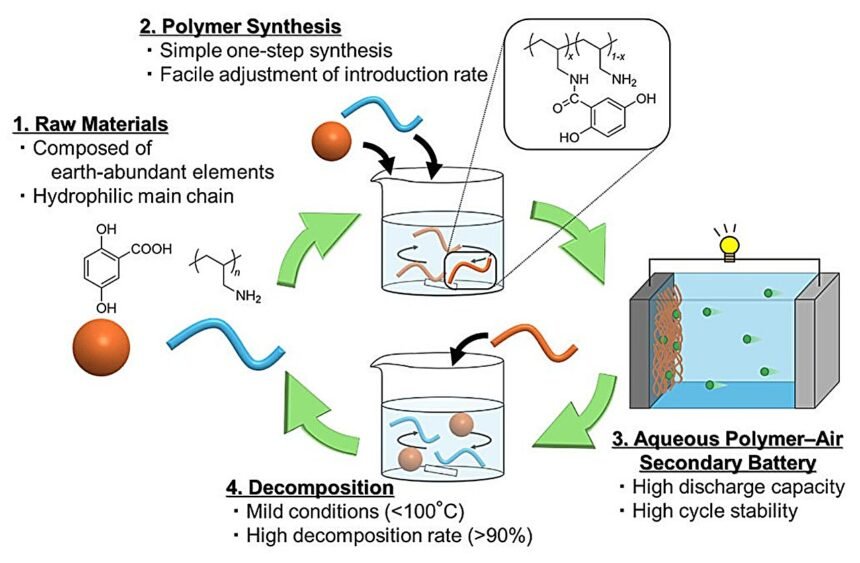
For organic redox polymers, the challenge has been hydrophobicity and issues with decomposition and recycling. In a recent study published in the Polymer Journal, researchers from Tohoku University and Nitto Boseki Co., Ltd., have made significant progress in overcoming these obstacles.
By incorporating p-dihydroxybenzene—an organic molecule with high charge storage capacity—into a water-soluble polyamine, the team developed a new organic redox polymer. This innovative approach allows the polymer to maintain high hydrophilicity, serve as an electrode-active material at room temperature, and be easily broken down into its raw components at low temperatures.
Associate professor Kouki Oka from the Institute of Multidisciplinary Research for Advanced Materials at Tohoku University emphasized the importance of this breakthrough, stating that it offers a design strategy to make hydrophobic redox molecules compatible with aqueous systems, combining high charge storage capacity with recyclability for sustainable battery research.
The study’s findings not only promote the use of water-based electrolytes to eliminate the fire risk associated with flammable solvents but also highlight the environmental benefits of using polymers made from abundant elements that can be efficiently decomposed, potentially reducing resource consumption and plastic pollution.
As the research team continues to assess the durability and performance of this new material for practical applications, the future looks promising for the development of recyclable water-based batteries.