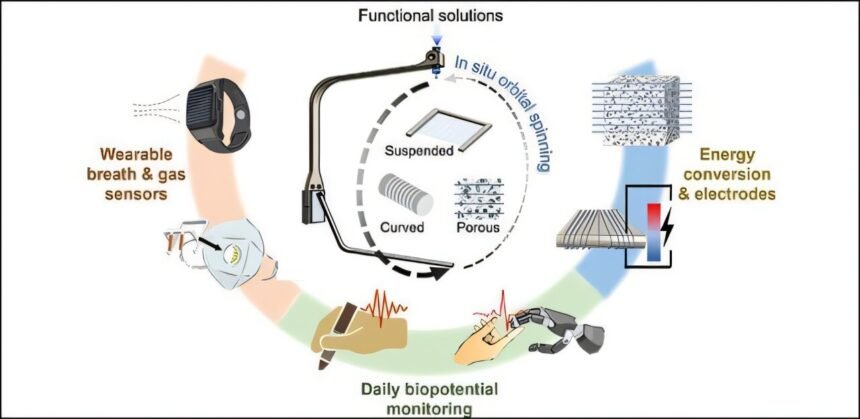
A groundbreaking study conducted by the University of Cambridge, in partnership with Hong Kong University of Science and Technology (GZ) and Queen Mary University of London, has introduced a revolutionary approach to integrating ultra-thin conductive microfibers into everyday objects, paving the way for enhanced human-device interactions.
Picture fibers thinner than a strand of human hair, capable of being customized to provide sensing, energy conversion, and electronic connectivity features to objects with varying shapes and textures like glass, plastic, and leather. The team of researchers has successfully achieved this, even extending their capabilities to unconventional materials such as porous graphene aerogels, thus unlocking a realm of possibilities for human-machine interactions in various everyday scenarios.
The researchers have devised a streamlined adaptive fiber deposition process utilizing 3D printing technology, tailored to meet the rapidly changing needs of users. This process allows for the instantaneous application of conductive material layers on different surface areas based on the object’s geometry, right at the point of use. The findings of this innovative approach have been documented in the journal “Advanced Fiber Materials.”
These transparent layers have the ability to capture real-time electrocardiogram (ECG) and surface electromyography (sEMG) signals. To demonstrate this functionality, the researchers conducted tests using a robotic hand, a pencil, and a plier tool.
A robotic hand was outfitted with an array of 400 microfibers composed of PEDOT:PSS, a conductive polymer, which were wrapped around the robotic finger. During ECG measurements, a human index finger was pressed against the microfibers on the robotic finger.
“This showcases a cost-effective method to swiftly equip robots with human-interactive sensing capabilities utilizing PEDOT:PSS microfiber electrodes,” remarked co-author Stanley Ka, a Ph.D. student in the Biointerface Research Group at the Department of Engineering. “Transient electronic skins like the one demonstrated here are vital in enabling robots and prosthetics to become more interactive with humans and replicate the sense of touch.”
The researchers envision diverse applications for the robotic hand, particularly in home care scenarios. In a remote care setting, an interactive robot could prove valuable for home-based care or telemedicine, serving as a remote monitoring device. For the elderly, a robot companion equipped with this technology could periodically monitor vital signs, including ECG signals, without the need for wearable devices. In certain emergency situations, the use of robotic systems equipped with ECG sensors can play a crucial role in assessing a person’s cardiac status before traditional emergency responders arrive. This innovative approach can provide vital information to first responders, enabling them to make faster and more informed decisions when treating patients in crisis.
To further enhance the capabilities of such robotic systems, researchers have developed a novel method for integrating ECG and sEMG (surface electromyography) sensors onto everyday objects like pencils and pliers. By wrapping an array of PEDOT:PSS microfibers around the handle of a pencil or plier, users can now monitor their cardiac and muscle activity in real-time while performing common tasks such as writing or gripping objects.
This cutting-edge technology not only benefits individuals by alerting them to abnormal ECG or sEMG patterns, but it also has significant implications for workplace safety. For workers in hazardous environments where plier tools are used, continuous monitoring of cardiac health can help prevent accidents and injuries caused by fatigue or stress.
Moreover, in collaborative scenarios where humans and robots interact closely, the integration of ECG and sEMG sensors can enhance communication and coordination between the two parties. By analyzing the data collected from the human operator, robots can adjust their behavior accordingly, ensuring a safer and more efficient working environment.
Lead researcher Professor Shery Huang highlights the durability and versatility of these microfiber electrodes, emphasizing their potential for revolutionizing medical diagnostics and wearable technology. The seamless integration of electronic functions onto everyday objects opens up a world of possibilities for enhancing human-machine interactions and improving overall well-being.
In conclusion, the development of customizable electronic functions on common objects represents a significant step towards a sustainable future of interconnected devices. This innovative approach not only enhances diagnostic and treatment capabilities but also paves the way for new forms of wearable technology that can improve health outcomes and quality of life.